

Home › Are reverse phone lookup sites safe?
Are reverse phone lookup sites safe?
Most promise a name and deliver a paywall. Here is how those sites work, where they go wrong, and why we check the number instead of naming a person.
On this page
The short answer
Using one will not usually harm your device. The risks are to your wallet, to your privacy, and to whoever's name comes up.
A reverse phone lookup takes a number and returns a name, and often much more. For a missed call that sounds like exactly what you need. In practice the name is frequently hidden behind a payment, frequently out of date, and, when the call was a scam, frequently the name of somebody who had nothing to do with it.
We know the model well, because this site used to work that way. It no longer does. This page explains how such sites operate, where they go wrong, and a safer way to decide about an unknown call.
How these sites work
They buy and collect data in bulk
Public records, marketing lists, old directories, data from apps and data brokers. The same sources feed the wider people-search industry.
They join it by phone number
Every record that ever carried the number is tied together, whoever held the number at the time.
They show a teaser
"We found a match." A first initial, a city, a blurred line. Enough to make the full result feel one step away.
They sell the rest
A single report, a trial or a subscription, often with extra "background" on the person offered at the same checkout.
Where it goes wrong
- The paywall after the searchYou give time, and sometimes an email address, before learning that the answer costs money.
- Trials that renewA low first price that becomes a monthly charge unless you cancel in time, and cancelling is not always easy.
- Stale namesPhone numbers are reassigned all the time. The name on file may be the person who had the number three owners ago.
- Faked numbersScam callers display numbers that are not theirs. The lookup then points at an innocent person, with confidence.
- Profiles of private peopleThe same product that names a caller can hand a stranger someone's address and relatives. That is a risk to the person looked up, not to the buyer.
- Results used for the wrong purposeA lookup result is not a background check. Using one to decide about a job, a tenancy or credit is against US law.
What they do, and what we do
We describe common practice here, not any one company. Some lookup services are careful and clear about their prices. Many are not.
A safer way to judge an unknown call
You rarely need to know who a caller is. You need to know whether to trust the call. That question has a better answer than a name:
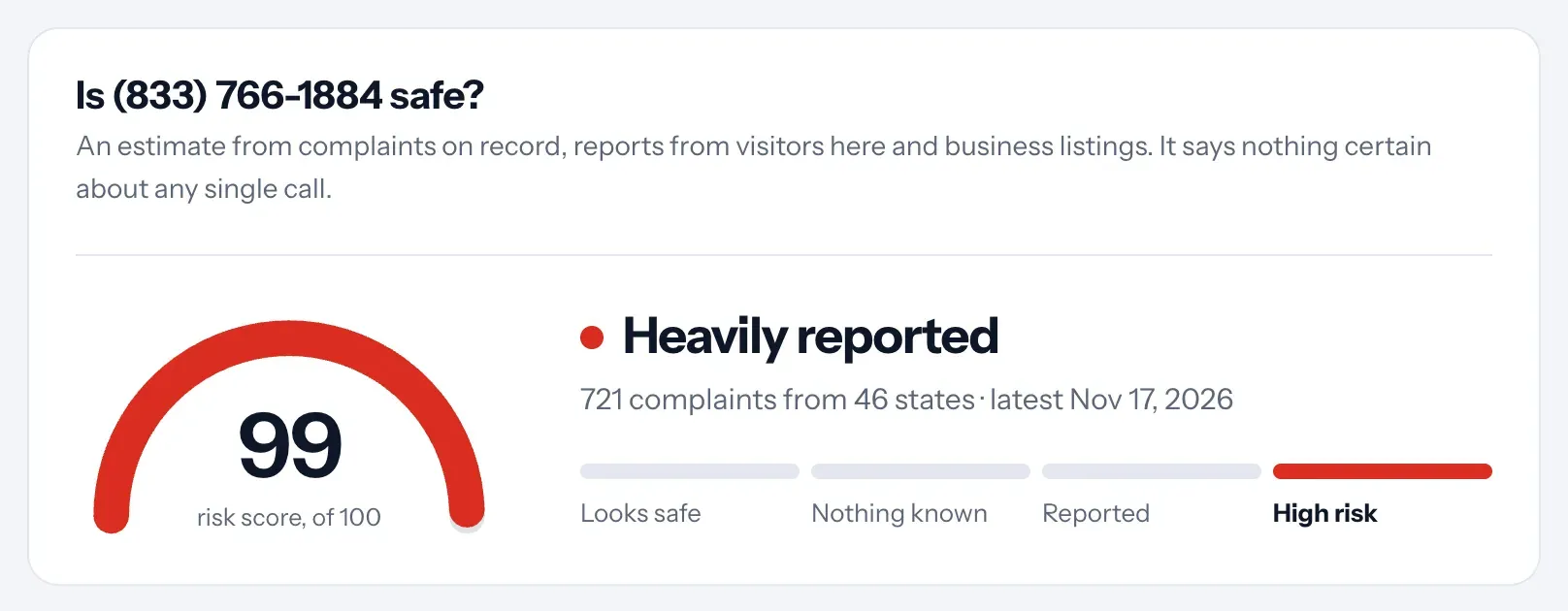
- Check what the number has done. We hold 1,523,420 complaints about 1,055,158 numbers. If others reported the number, you will see what the calls were about and how recent they are.
- Let it go to voicemail. A real caller leaves a message.
- Call back on a number you already have. For a bank, a clinic or a government office, use the number on your card, a bill or the official website, never the one that called.
- Report it. Two clicks here, and a minute with the regulator: see where to report spam calls.
If a site already has your details
People-search and lookup sites generally offer an opt-out, though each has its own form and the entry can return when their data is refreshed. Search for the site's name with "opt out", use the form on its own domain, and never pay a site to remove you from itself.
Here there is nothing about you to remove, because we hold no names. If a page shows a business with your number, or you want a page about your own number corrected, use the removal request form.
Questions about lookup sites
Are reverse phone lookup sites legal?
In the United States, generally yes: they compile information from public records and commercial data. What is restricted is how the results are used. Under the Fair Credit Reporting Act, information from a site that is not a consumer reporting agency may not be used to decide about employment, housing, credit or insurance.
Is a free reverse phone lookup really free?
Rarely all the way. Many sites run the search for free and charge to show the result, or sell a low-priced trial that renews as a monthly subscription. Read the checkout page, and check your card statement afterwards.
Can a lookup site tell me who really called?
Only who the number was last tied to in its data, which may be out of date. And if the call was from a scammer, the number on your screen was probably faked, so the name it leads to belongs to someone uninvolved.
How do I judge an unknown call without a name?
Look at what the number has done. If hundreds of people reported recorded messages from it this month, a name would add nothing. Check the number here, let unknown calls go to voicemail, and call organisations back on a number you already trust.